
Quality of Tidal and Water Level Data
The information on tides and water levels shown in the “Se havnivå” service is divided into four quality classes, ranging from high to low.
The Norwegian Mapping Authority has made a preliminary assessment of the quality of tidal and water level data. We will review several older time series of water level, and together with new data, this will form the basis for regular updates of the quality classification.
Se havnivå Water Level and Tides
Se havnivå provides information about water level, tides, vertical datums, land uplift and future sea level projections for the Norwegian coast:
Quality classes
Quality classes range from 1 to 4, where Class 1 represents the highest quality. Classes 3–4 are of such poor quality that the Norwegian Mapping Authority does not publish data (for example, the stretch between Egersund and Lista).
Quality for tides and estimated water level are assessed separately.
The classification follows SeaDataNet’s L20 (DataNet Measured Qualifier Flags), which ranges from 0–4.
Water level – data quality shown in map
You can zoom in, toggle different classes on and off, and click on locations to see the quality class. Permanent tide gauges are also shown on the map.
Tides – data quality shown in map
Similarly, you can check quality of tidal data by zooming, toggling classes, and clicking for details.
About the quality of tidal data
Almost all coastal locations are classified as Class 2, meaning the data is of good quality and suitable for most purposes.
Where tides are calculated based on a long and reliable time series nearby, the data is Class 1 (highest quality). This applies near permanent tide gauges and some other locations with good historical data.
Between tide gauges, tides are estimated. The quality depends mainly on how much the tidal pattern changes in that area.
NB! Attention
Some areas marked as Class 2 may actually be Class 1, but this has not yet been verified.
Until we have sufficient measurements to produce a tidal prediction, we cannot confirm Class 1 quality. The classification should therefore be seen as “at least this class.”
About the quality of estimated and forecasted water level
Currently, quality is assessed mainly near permanent tide gauges, where we have long-term measurements and good control. Both observed and forecasted water levels are rated as Class 1 near permanent tide gauges.
Elsewhere, water levels are based on a model combining estimated tides with surge from the most representative permanent gauge. Hence, the quality depends on:
Tidal data quality + how well the surge matches the area.
So far, very few locations have been assessed for the quality of the surge. Most coastal areas therefore lack rating of water level quality.
This does not mean water levels are poor in these areas. We believe the quality is “good enough” in most places, but this has not yet been verified.
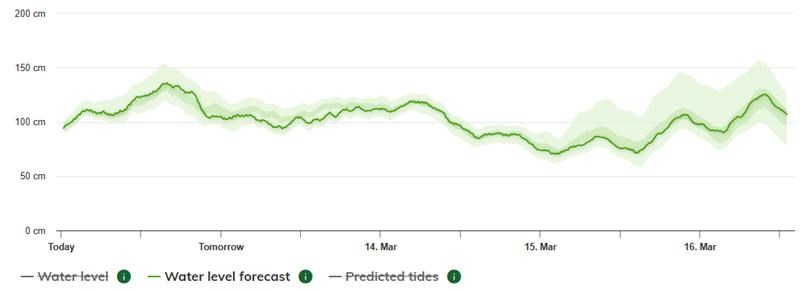
You can view forecast uncertainty in a separate graph when searching in “Se Havnivå”. Forecasts are updated twice daily.
The mail has been sent!